Work Certificates
Codes
Certificate wording
Switzerland
Swiss Work Certificate Codes: What the Wording in an Arbeitszeugnis Really Means
Z
ZeugnyAIOctober 7, 2026
5 min read
Share:

Secret codes that let an employer hide criticism between the lines are not allowed in Switzerland. A work certificate (Arbeitszeugnis) has to be clear, and an employer who wraps criticism so that only insiders understand it breaks that rule. The special language of certificates (Zeugnissprache) hasn't disappeared, though. HR staff pay attention to gradations, to gaps and to the closing paragraph, and some employers use such wording without meaning any harm.
Many of the code tables you find online come from Germany and map German school grades onto phrases. They're of limited use for Swiss certificates. If you want to read or write a certificate, learn how the mechanisms work instead of relying on a table.
The best-known gradation is in the overall assessment. HR professionals read zu unserer vollsten Zufriedenheit ("to our fullest satisfaction") or stets zu unserer vollen Zufriedenheit ("always to our full satisfaction") as very good, zu unserer vollen Zufriedenheit ("to our full satisfaction") as good, and zu unserer Zufriedenheit ("to our satisfaction") as adequate. Qualifiers such as im Grossen und Ganzen ("on the whole") or weitgehend ("largely") lower the statement considerably.
What matters more than the single word is whether the whole certificate fits it. "Full satisfaction" without any concrete statements about performance sounds hollow. A carefully reasoned certificate with a plain formula can be stronger than one packed with superlatives.
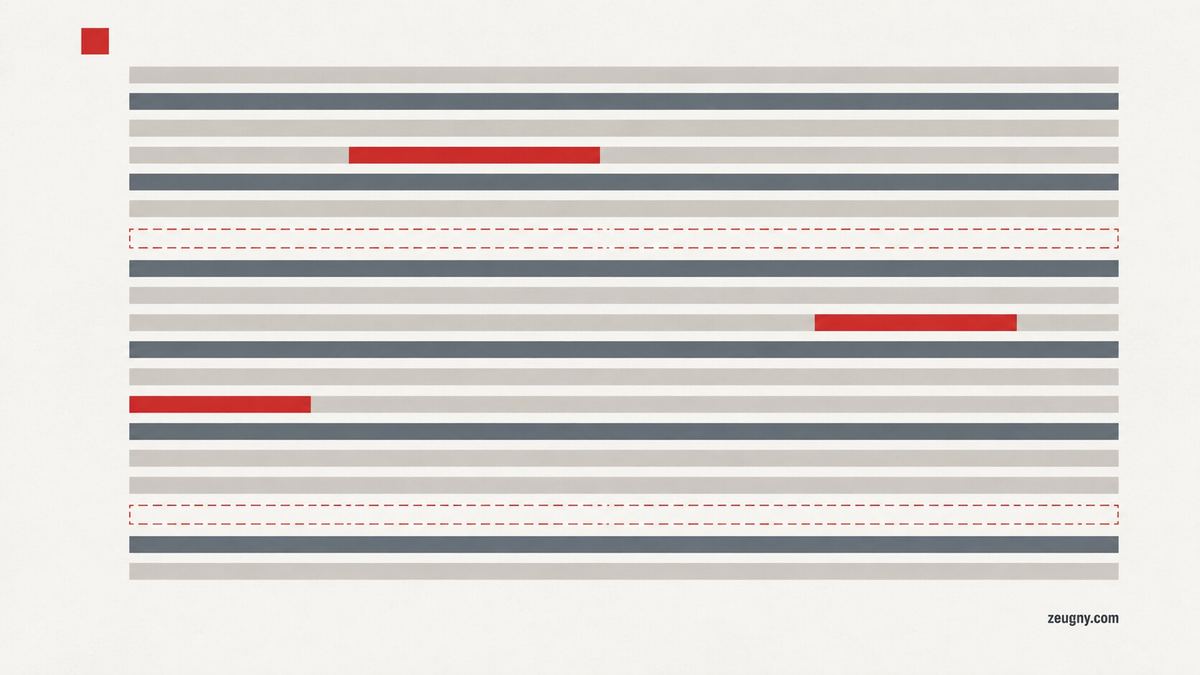
Gaps are the most common signal. When a statement you'd expect is missing, readers take it as criticism. For a manager, it stands out if leadership isn't mentioned. If the certificate praises how someone treated colleagues but says nothing about managers, readers wonder why.
Lopsided weighting has a similar effect. If a sales manager's certificate dwells on her tidy filing and mentions revenue only at the end in a side clause, the weighting says more than the words.
Words like meistens ("mostly"), in der Regel ("as a rule") or weitgehend ("largely") take the force out of praise.
Readers also notice passive phrasing. Die ihr übertragenen Aufgaben erledigte sie zuverlässig ("She reliably completed the tasks assigned to her") sounds neutral. It can still be read as saying she only did what she was told and showed no initiative of her own.
Er bemühte sich ("he made an effort") or sie zeigte grosses Interesse ("she showed great interest") describe effort rather than success. Such stock phrases count as a euphemism for weak performance, which is why they aren't permitted.
Finally, contradictions stand out. A certificate that confirms very good performance but ends with no thanks and no regret about the departure raises questions. Readers then assume the parting wasn't on good terms.
Yes, in a milder form. In French-speaking Switzerland and in Ticino, readers also distinguish between à notre satisfaction and à notre entière satisfaction, or con nostra soddisfazione and con nostra piena soddisfazione ("to our satisfaction" versus "to our full satisfaction"). Elaborate code systems like those in the German-speaking world are less common there.
A clear certificate says what it means and gives reasons. Concrete results help more than a satisfaction formula on its own: which projects someone led, what changed as a result, how customers and colleagues responded. Criticism may appear if it's true and relevant, but it has to be stated openly.
Before signing, check three things. Do the overall assessment, the individual statements and the closing statement agree? Is an important duty or an important aspect of conduct missing? Are there words like "made an effort" or "mostly" that weaken a statement without you meaning them to?
Companies that deliberately avoid certificate language can hand employees and managers a short information sheet. It states that the company issues certificates without codes and takes the uncertainty away from readers.
Read the certificate as a whole, and start with the closing paragraph, because that's where you see fastest how the employment ended. Then compare the overall assessment with the individual statements. Over-interpreting single words tends to mislead, because not every phrase was chosen on purpose. If a passage bothers you, raise it with your employer and be specific. Disputing a Swiss Work Certificate explains how.
In ZeugnyAI you rate each aspect on a scale of 1 to 5. ZeugnyAI words every sentence to match that rating, and for any sentence you can ask which rating it expresses. No gradation ends up in the certificate that you didn't choose.
Write a work certificate with ZeugnyAI →
For structure and content, read our guide to Swiss work certificates.
General information, not legal advice for individual cases.
Why HR staff read the end of a Swiss work certificate (Arbeitszeugnis) first, what belongs in the closing statement and example closings for different reasons for leaving.

What you can do in Switzerland about an incorrect or incomplete work certificate (Arbeitszeugnis), which deadlines apply, who has to prove what and what proceedings cost.

Qualified and simple work certificates are German terms. What they correspond to in Switzerland, who chooses which form and why the difference matters when you apply for jobs.