Work Certificates
Correction
Employment law
Switzerland
Disputing a Swiss Work Certificate: Deadlines, Procedure and Costs
Z
ZeugnyAIOctober 7, 2026
4 min read
Share:
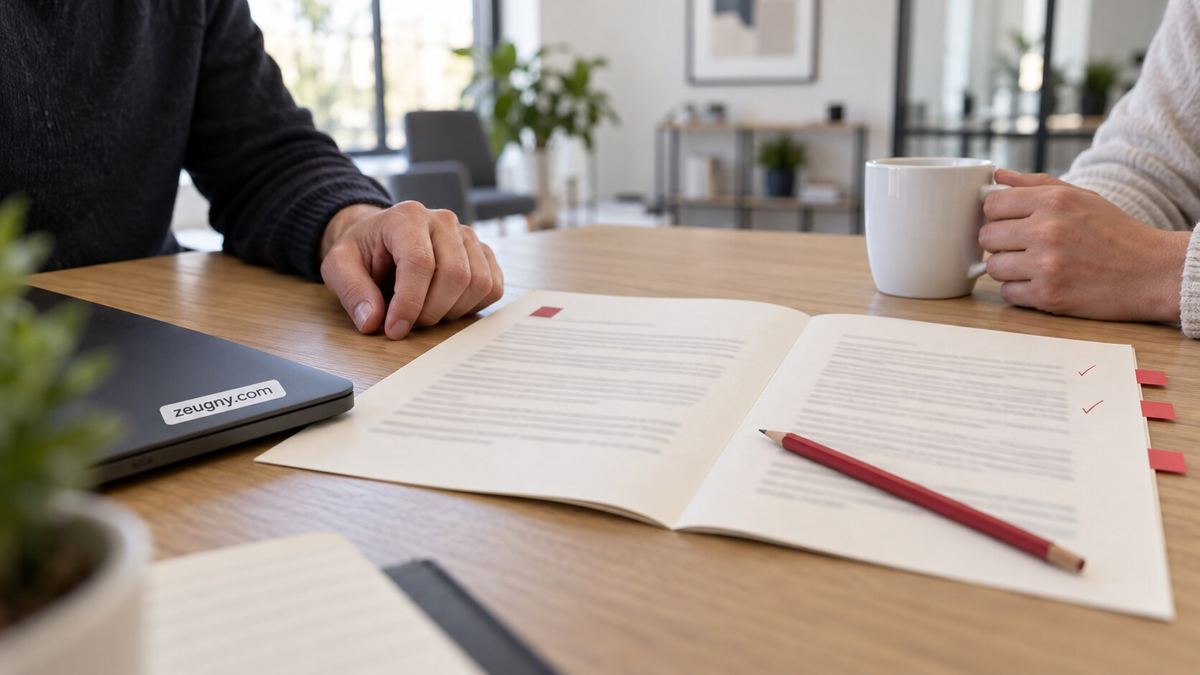
If a work certificate contains false facts, leaves out important duties or paints a misleading picture overall, the employer has to correct it. The right to a correction, like the right to the certificate itself, becomes time-barred only ten years after the employment ends (Art. 127 of the Swiss Code of Obligations, CO). There's no shorter statutory deadline. Acting quickly still pays off, while everyone involved still remembers.
You can demand a correction if the certificate contains false facts, such as a wrong end date or a wrong job title, if significant duties or aspects are missing, if it contains hidden criticism or impermissible stock phrases, or if the overall assessment doesn't reflect your actual performance.
You have no right to particular wording. The employer decides how to phrase it, as long as the certificate is truthful, benevolent, complete and clear. A sentence you simply don't like is no reason for a correction.

Start with a conversation. Go through the certificate and note the passages that are wrong or incomplete. Back up every change with evidence, for example target agreements, appraisal meetings, an earlier interim certificate (Zwischenzeugnis) or emails in which customers or managers praised your work. Many disputes are resolved at this stage.
Next, send a written proposal. Set out the changes you want specifically, ideally as proposed wording for the sentences concerned. Give a reasonable deadline for a reply, such as two to three weeks.
If no agreement is reached, the next step is a request for conciliation. Proceedings start before the conciliation authority (Schlichtungsbehörde) at the place of work or at the employer's registered office. There, the parties first try to reach an agreement. If that fails, you can file a claim with the labour court (Arbeitsgericht). It helps to give the court the wording you want for the whole certificate, not only your criticism.
The corrected certificate carries the date of the original version. That way, later readers can't tell there was a dispute.
If you claim an above-average assessment, you generally have to prove the better performance. If the employer asserts negative facts or below-average performance, it has to prove them. A recent interim certificate is valuable here. If the final certificate is clearly worse, the employer must be able to explain what has changed since.
For disputes arising from employment, the conciliation procedure is free of charge up to an amount in dispute of CHF 30,000, and no court costs are charged in this range before the court either (Art. 113 and 114 of the Swiss Civil Procedure Code, CPC). A certificate correction is almost always below that amount. Lawyers' fees can still arise, your own and in some circumstances those of the other party. Many trade unions, professional associations and legal expenses insurers advise their members on certificate questions.
You can ask for a work certificate after the employer has dismissed you too, and it still has to be benevolent. In principle, the reason for the dismissal only goes in if you want it to. The employer may mention a summary dismissal if it's significant for the overall picture, but without details.
Changing the certificate yourself is not an option. A work certificate is a legal document, and anyone who alters it on their own commits a criminal offence.
Often the quickest route is to give your employer a complete, correct certificate as a proposal. In ZeugnyAI you enter duties and ratings and get a well-structured draft that you can submit with your request for correction.
Create a draft certificate with ZeugnyAI →
How to spot hidden criticism is explained in Swiss Work Certificate Codes.
General information, not legal advice for individual cases. In a dispute, get advice from a specialist.

When a Swiss work certificate (Arbeitszeugnis) is due, what goes in it, how to structure it, who signs it and what to do if it's wrong. With example wording.

Two templates for a Swiss confirmation of employment (Arbeitsbestätigung), for finished and ongoing employment, with what belongs in it under Art. 330a para. 2 CO and what does not.
Qualified and simple work certificates are German terms. What they correspond to in Switzerland, who chooses which form and why the difference matters when you apply for jobs.