Work Certificates
Full certificate
Terminology
Switzerland
Full vs Simple Work Certificate: What Qualified Arbeitszeugnis Means in Switzerland
Z
ZeugnyAIOctober 7, 2026
3 min read
Share:

If you search for "qualified work certificate" (qualifiziertes Arbeitszeugnis), you'll mostly land on German websites. The terms come from German employment law. Germany distinguishes the simple certificate (einfaches Zeugnis), which states only the nature and duration of the work, from the qualified certificate, which also assesses performance and conduct. Switzerland has the same distinction, with different names and the default the other way round.
As the rule, Art. 330a of the Swiss Code of Obligations (CO) provides for a certificate that covers the nature and duration of the employment as well as performance and conduct. In Switzerland it's usually called a full certificate (Vollzeugnis), a qualified certificate or simply a work certificate (Arbeitszeugnis). At the employee's express request, it's limited to the nature and duration of the employment. This form is called a confirmation of employment (Arbeitsbestätigung), sometimes also a simple work certificate.
So in Switzerland, if you don't say anything else, you get a full certificate. A confirmation of employment is issued only on request, and the employer may not hand one out on its own initiative in place of a full certificate.
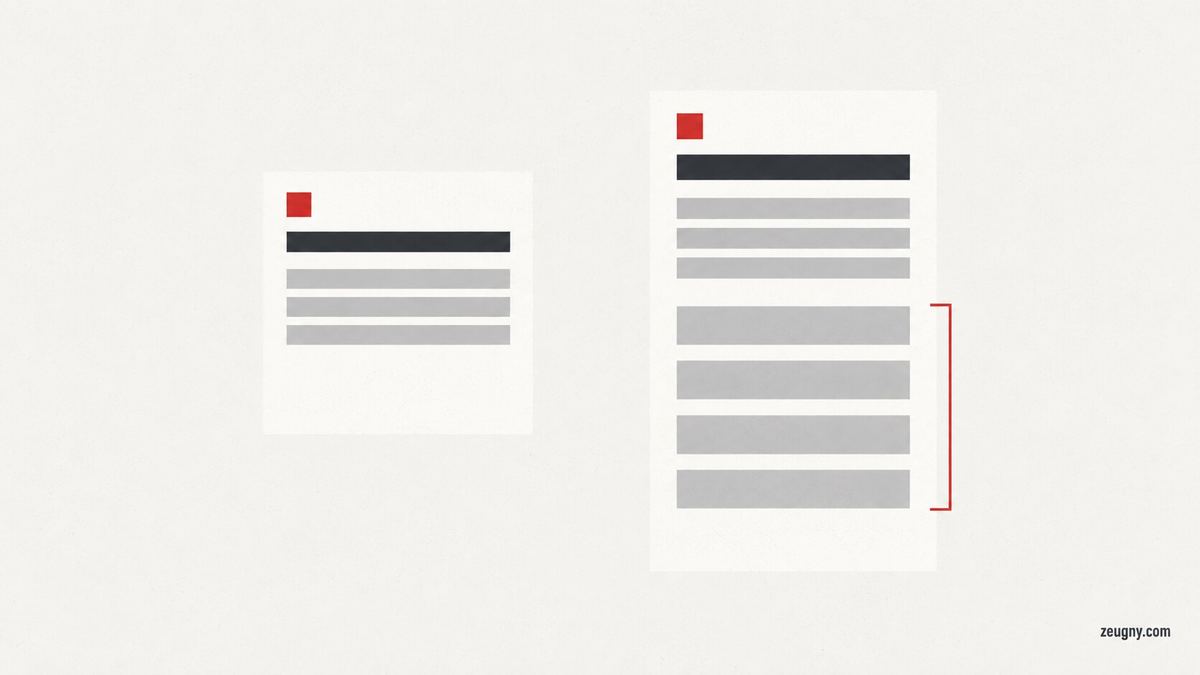
A full certificate describes the role and duties and then assesses expertise, working style, results and conduct towards managers, colleagues and customers. It ends with an overall assessment and usually with thanks and good wishes. Our Swiss work certificate template shows what that looks like in practice.
A confirmation of employment, by contrast, gives only personal details, role, start date and end date. You'll find a template in Confirmation of Employment in Switzerland.
For job applications, the full certificate is almost always the better choice. HR staff in Switzerland expect it, and a confirmation of employment in an application almost always leads to the question of why there's no proper certificate.
A confirmation of employment can make sense after very short employment, when there's hardly anything to assess, or after a conflict, when the employee would rather do without an assessment. It's also enough as proof for a landlord or an authority. According to a widely held view, you can ask for both.
If you've worked in Germany and now work in Switzerland, two differences matter. In Germany the simple certificate is the basic form and you have to ask for the qualified one. In Switzerland it's the reverse. And German grade tables for certificate wording can't be transferred one to one to Swiss certificates. Swiss Work Certificate Codes explains why.
You can create both in ZeugnyAI. For a full certificate, you rate each aspect on a scale of 1 to 5 and ZeugnyAI writes the text. For a confirmation of employment, a short form is enough.
Create a full certificate → · Create a confirmation of employment →
General information, not legal advice for individual cases.

What you can do in Switzerland about an incorrect or incomplete work certificate (Arbeitszeugnis), which deadlines apply, who has to prove what and what proceedings cost.

When and how often you can ask for an interim work certificate (Zwischenzeugnis) in Switzerland, a sample request letter and an example of how an interim certificate is structured.

Hidden codes are not allowed in Swiss work certificates (Arbeitszeugnis), yet HR readers still pick up on gradations and gaps. How to spot them and how to write a certificate without them.